
The Titanic Meets an Iceberg: Eight Musicians Who Kept Playing
The Opening
The Titanic’s story is not only the story of a ship. It is also the story of people who faced danger they could not stop—and of eight musicians who tried to help others through it.
They had come aboard to play music. Their work belonged at meals, concerts, and Sunday services. But after the ship struck an iceberg, their work took on a different purpose.
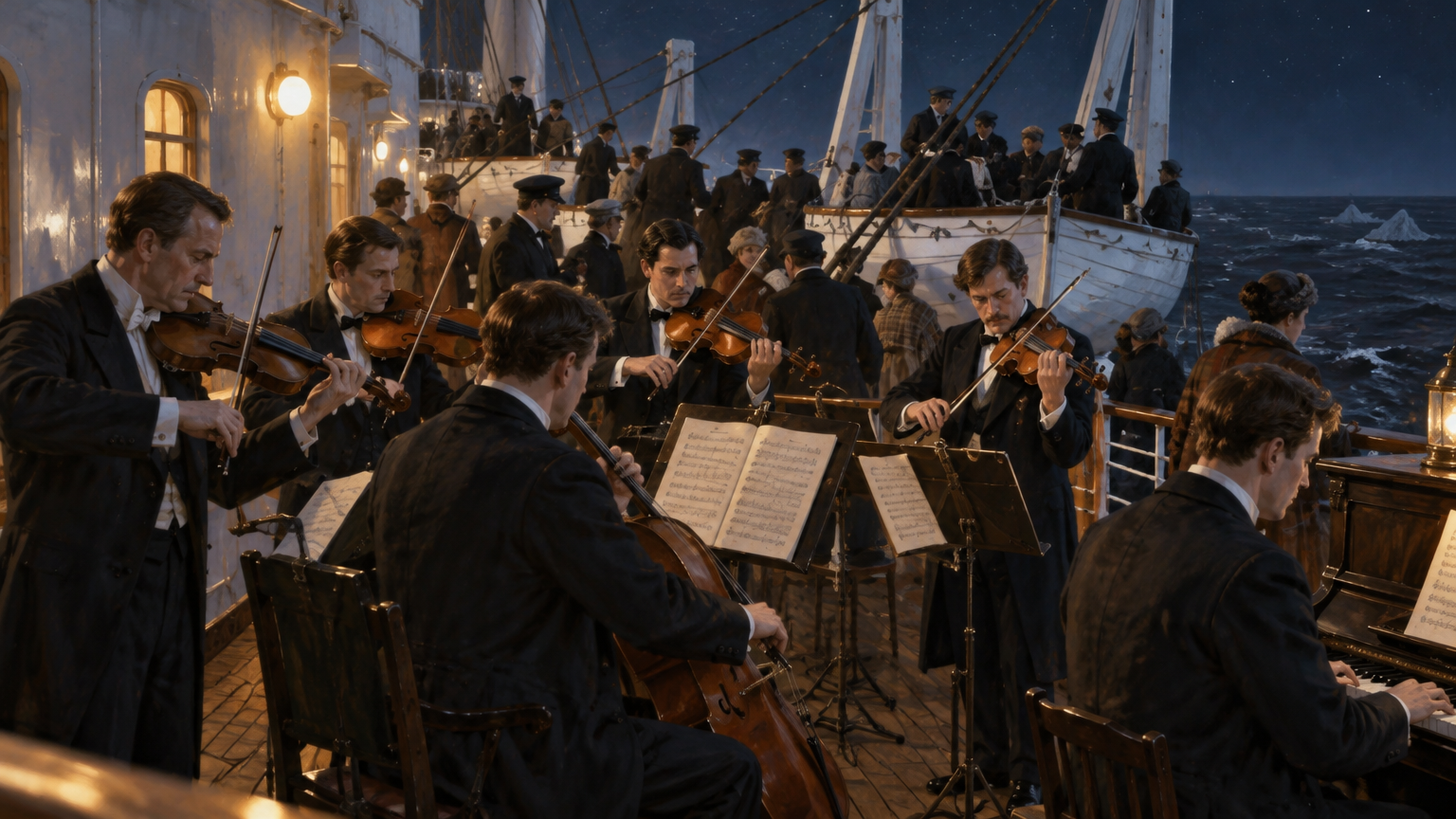
As the crew loaded lifeboats, Wallace Hartley and his fellow musicians played to help keep the passengers calm.
They could not repair the ship with a song. They could not make the sea safe. Yet they offered something that mattered in those terrible hours.
Before we draw a lesson from the Titanic, we should pause here. This was not simply a famous mistake for later generations to discuss. It was a real loss of human life. Every musician in that group died.
The Historical Setting
The Titanic was making its first voyage. The musicians boarded at Southampton and traveled in second class. They were hired through C. W. & F. N. Black, a music agency in Liverpool, rather than being directly on the White Star Line’s payroll.
There were eight musicians, but they did not usually perform as one band.
Wallace Hartley, a violinist and the official bandleader, led a group of five. They played at teatime, after-dinner concerts, Sunday services, and other events.
A separate group of three played in the ship’s À La Carte Restaurant and Café Parisien. Georges Krins played the violin. Roger Bricoux played the cello. William Brailey played the piano.
These were working musicians with training and experience. Their music was part of the service offered aboard the ship. Then the Titanic struck an iceberg, and the setting for their work changed completely.
The Story
It helps to know a little about the people behind this well-known account.
William Brailey had studied piano at school and had worked as a hotel musician. He later served as an army musician before returning to civilian life. Before joining the Titanic, he played aboard the Carpathia, where he met Roger Bricoux.
Bricoux was the son of a musician. He studied music in Europe and worked in hotels and other settings before going to sea. At twenty, he was the youngest of these two friends. Brailey was twenty-four.
Another violinist, John Law Hume, known as Jock, had already played on at least five ships. He was hired for the Titanic’s first voyage because of his good name as a musician. He was twenty-one.
John Frederick Preston Clarke played the bass violin. He had worked with a theater orchestra in Birkenhead and had also played with the Royal Liverpool Philharmonic.
These details matter. The men were not symbols when they stepped aboard. They had learned their skills, held jobs, and built lives. Their story deserves more than a quick mention at the edge of a larger disaster.
After the collision, Hartley and his fellow musicians began playing to help keep people calm while the lifeboats were loaded. Many survivors later said the band played until the very end.
We should be careful not to add scenes that the record does not give us. We do not need to invent a speech from Hartley or a private promise among the men. Their reported actions already carry weight.
In the early hours of April 15, 1912, the Titanic sank. All eight musicians died.
The Turning Point
For the musicians, the turning point came when music for pleasure became music offered in a crisis.
The work itself was familiar. The purpose was now urgent: to help frightened people remain calm as the crew worked to get them into lifeboats.
One part of the account has become especially well known. According to tradition, the band’s final tune was the hymn “Nearer, My God, to Thee.” But that is not certain. Other accounts name “Songe d’Automne,” also called “Autumn.”
We should not turn a moving tradition into a proven fact. Nor should we build a claim about the men’s private faith on a song whose place in the story remains disputed.
What is supported is meaningful enough: the musicians played during the sinking, seeking to calm passengers, and none of them survived.
Their courage did not make the loss less terrible. It gave those who lived through it an act of service to remember.
What History Teaches Us
In a collection about history’s greatest mistakes, it is tempting to make every event fit a neat lesson. But honest history asks us to be more careful than that.
The research behind this account tells us about the musicians. It does not give enough evidence to explain the ship’s speed, the handling of ice warnings, or the number of lifeboats. Those questions need their own careful study. We should not use the band’s story as proof of decisions it does not explain.
Still, there is room for a thoughtful lesson.
Human skill has limits. A ship can carry trained workers and talented people, yet still face danger beyond their power to overcome. Respect for those limits is not weakness. It is a reason to prepare, to listen, and to take care.
There is also a difference between preventing harm and responding bravely after harm begins. We need both caution and courage. Honoring courage should never make us less serious about safety.
The musicians remind us of another truth: when people are afraid, steady acts of care matter. We cannot measure exactly what their music did for each passenger. But we know why they played—to help others remain calm.
I want to encourage you to hold both lessons together. Take danger seriously before a crisis comes. And when others are suffering, do not overlook the help you can offer.
The Titanic’s musicians could not stop the sinking. Their story is not a promise that brave service always ends in rescue. It is a sober reminder that care for others can remain meaningful even when the outcome is heartbreaking.
A Final Thought
Respecting our limits does not mean living in fear. It means being willing to listen, prepare, and change course when needed. And when trouble comes, may we be people who bring care rather than confusion. Let us honor courage without forgetting caution, and remember that behind every great tragedy are real people whose lives mattered.