Before the First Thanksgiving: The Long Road to Plymouth
The Opening
A holiday story can become so familiar that we stop asking what we truly know about it. We remember a feast. We remember people sharing food. But the people behind the story had lives that cannot fit into one picture.
To approach Plymouth honestly, we need to slow down. We need to leave room for hardship, faith, and the challenge of living among people whose ways are different from our own.
There is also a limit to this account. The research provided follows the Pilgrims’ journey toward Plymouth, but it does not describe the 1621 harvest gathering. It gives no details about the Wampanoag people, Squanto’s work, or the terms of an alliance. Those parts of the planned story cannot be told responsibly from these notes alone.
What the research does give us is a revealing story about the years before Plymouth—a story that helps us see the settlers as people rather than figures in a holiday scene.
The Historical Setting
The Pilgrims were English colonists who crossed to North America aboard the Mayflower and established Plymouth Colony in 1620. Their settlement stood at what is now Plymouth, Massachusetts.
But their journey did not begin with that ship.
Their leaders came from churches whose members believed they needed to leave the Church of England. They were called Separatists because they wanted their congregations to worship apart from that church. Puritans, by contrast, wanted to change the established church from within.
That difference carried a heavy cost. English law required people to attend official church services. Missing them could bring fines. Holding services outside the official church could lead to larger fines and prison.
William Bradford, who later recorded the group’s history in Of Plymouth Plantation, described people being jailed, having their homes watched, and leaving their houses and means of support behind.
For these families, the question of where to worship was tied to another question: Where could they live in peace?
The Story
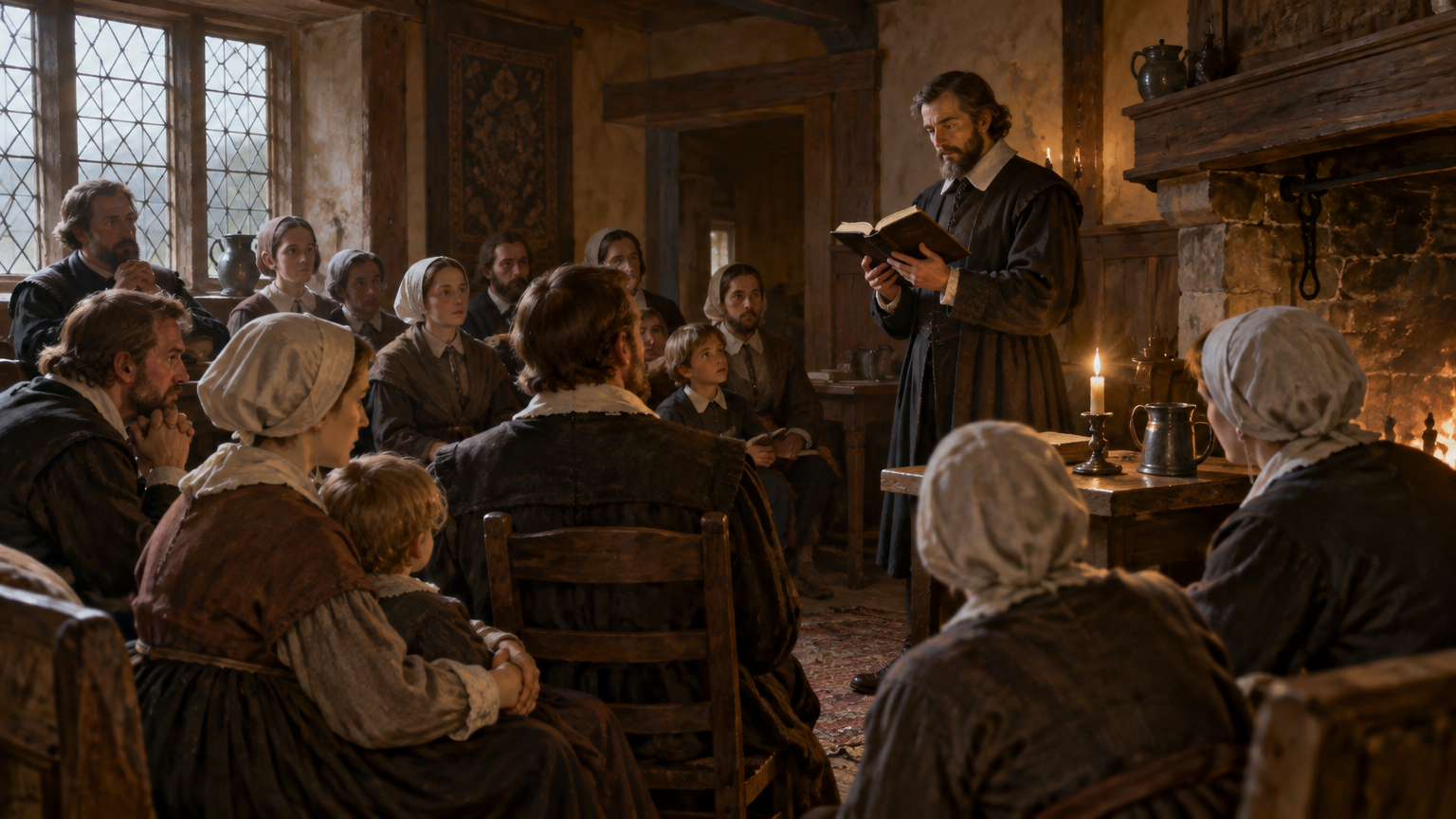
One gathering place was a manor house in Scrooby, England. William Brewster lived there while working as the village postmaster and as an officer serving the Archbishop of York. Beginning in 1606, a Separatist congregation held services in the house.
Richard Clyfton served as pastor. John Robinson served as teacher. Brewster served as the church’s leading elder.
Here is a detail worth noticing: before Brewster became part of the Plymouth story, his work included handling the mail. These were not people who had always lived outside ordinary society. They held jobs, kept homes, and faced real losses when their beliefs brought them into conflict with the law.
Brewster resigned from his postmaster position in 1607. That same year, he was fined £20 for failing to follow church requirements.
Around 1607–08, the Pilgrims moved to the Netherlands. They lived in Leiden, a busy city of about 30,000 people. There, they found greater freedom to practice their faith.
Freedom, though, did not make every part of life easy.
Some found work at Leiden University. Others worked with cloth, printing, or brewing. People who had come from the countryside often struggled with city jobs. The language barrier made earning a living harder, too.
Housing was built for some of those in need on land bought by Robinson and three partners.
Bradford’s account held both sides of the experience together. The people valued peace and the comfort of their faith more than wealth. Yet the living they built required hard, steady work.
Their leaders kept learning and working as well. Brewster taught English at the university. Around 1616, he obtained printing equipment through a business effort funded by Thomas Brewer. Robinson enrolled at the university in 1615 to work toward a doctorate.
Before there was Plymouth, there were classrooms, workshops, rented lives, and difficult choices in a Dutch city.
The Turning Point
By 1617, the congregation was fairly secure, but its future remained uncertain.
Bradford noted that hard living had begun to wear people down. Some had spent their savings and returned to England. Younger members were leaving to seek work and adventure elsewhere.
The parents and leaders also worried that their children were becoming more Dutch. The congregation feared that, over time, it might no longer survive as the community they knew.
These concerns helped lead them toward another move. The chance to share their faith in a distant land mattered as well. They arranged financial support from investors and eventually established Plymouth Colony in 1620.
Even the name offers a small surprise. John Smith had named the territory New Plymouth in 1614, years before the Mayflower settlers established their colony.
What History Teaches Us
The documented story stops short of the harvest feast, but it still asks something of us.
We can respect the Pilgrims’ search for religious freedom without treating their experience as the whole history of Plymouth. A full account of the 1621 gathering also needs careful research about the Wampanoag people and Squanto—not simply their names added to an English story.
That is where reflection begins. Understanding another culture means more than noticing the help its people gave someone else. It means making room for their lives, their needs, and their side of the story.
I want to encourage you to carry that care into the way you remember history. Gratitude does not require a simple story. Respect does not require us to hide hard questions. Sometimes the most honest beginning is to say what we know—and make room to learn what we do not.
A Final Thought
A shared table can be a lovely picture, but real understanding asks us to look beyond the picture. Every person at that table has a story worth hearing. Let us be thankful enough to remember the good, humble enough to admit what we do not know, and respectful enough to keep listening.