
The Lights Came On: Edison’s Pearl Street Breakthrough
The Opening
A light can seem like a small thing—until you think about what it takes to keep it shining.
A useful idea needs more than a moment of success. It needs a way to reach people. It needs a system that turns a promising invention into something they can use.
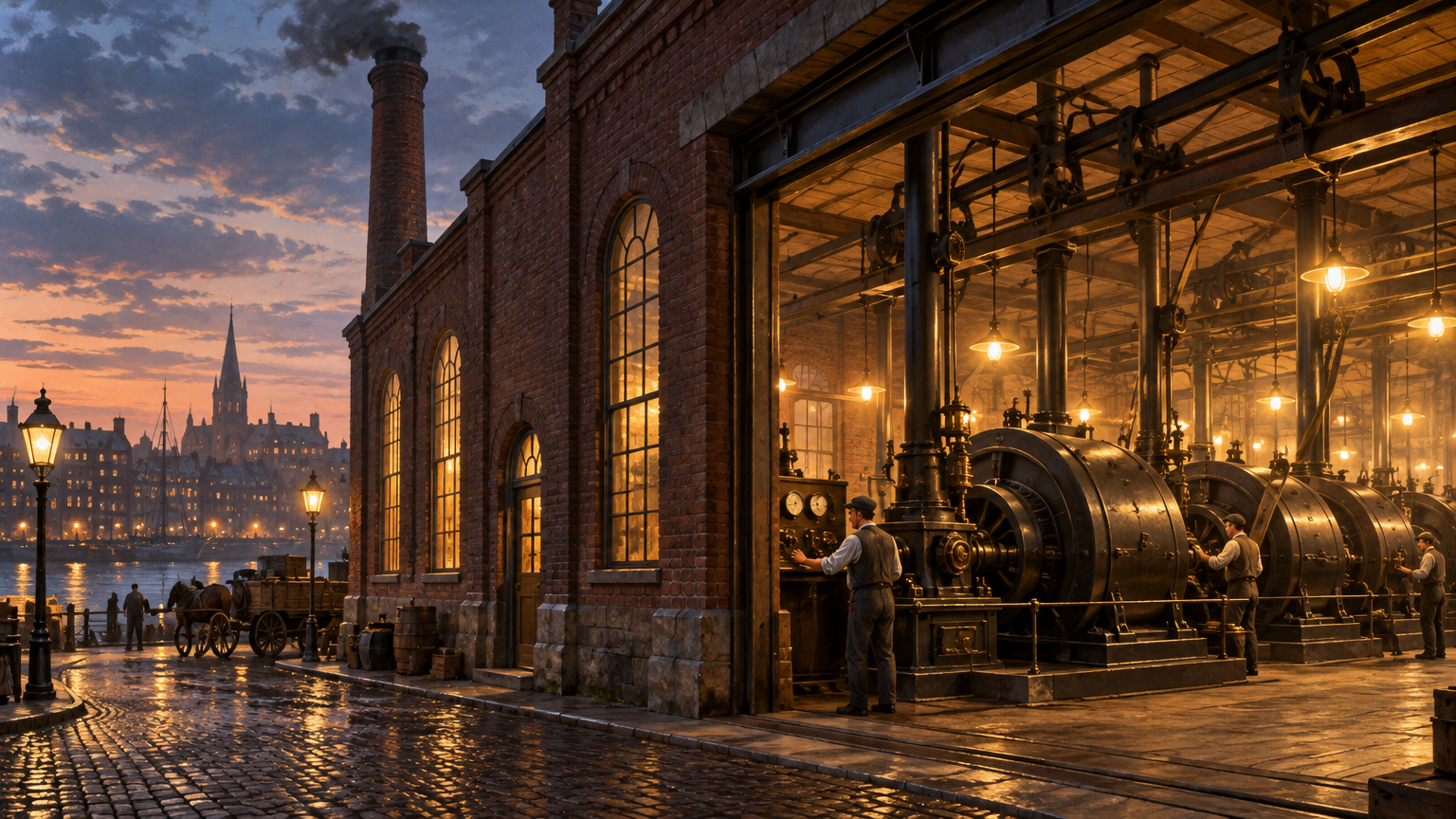
On September 4, 1882, Thomas Edison’s Pearl Street Station opened at 257 Pearl Street in Manhattan. It was his first central power station and, according to the supplied history, the first commercial power plant in the United States.
That address marked an important step. Edison was not simply offering an electric light. His company was building a way to supply the power behind it.
We do not need to add an imagined crowd or a speech to make this story matter. The documented event is striking enough: a power station opened in New York City, and a new kind of public service began to take shape.
The Historical Setting
The work had a clear starting point before Pearl Street opened. On December 17, 1880, Edison established the Edison Illuminating Company. Its purpose was to build electrical generating stations, beginning in New York City.
That purpose helps us understand the size of the task. A lamp was one part of the plan. Generating the electricity to serve customers was another.
Less than two years after the company was formed, Pearl Street Station began operating.
It is tempting to tell this as a simple tale of doubters giving way to wonder. But the supplied history does not record what customers or neighbors said on opening day. It does not give us their fears, their questions, or their reactions when the lights came on.
We should leave those voices unwritten rather than put words in their mouths.
What we can follow is the work itself: a company formed, a station opened, and more stations followed. The Edison Illuminating Company became a model for other local electric companies established across the United States during the 1880s.
The Story
Pearl Street’s importance went beyond supplying electricity. The station was also the world’s first cogeneration plant. That means it produced both electricity and useful heat.
That detail is easy to pass over. Yet it gives us another way to appreciate the project. This was not only about making power. It was also about putting more of the plant’s output to use.
The growth that followed gives the story its wider reach.
In November 1882, just months after Pearl Street opened, the Edison Electric Illuminating Company of Shamokin, Pennsylvania, was established. In 1883, its station became the second three-wire electrical station in the world—a system that used three wires to deliver power.
The first such station was Edison’s plant in Sunbury, Pennsylvania. It opened on July 4, 1883, and Edison attended the opening ceremony. His visit is still remembered there through the Edison Hotel and a monument outside the town.
On October 1 of that same year, another three-wire plant opened in Brockton, Massachusetts. It could supply about 1,600 lamps. The Brockton station later earned a place on the National Register of Historic Places.
These were separate places, each with its own part in the story. New York was not the whole story of electric power. Pennsylvania and Massachusetts were part of its early growth, too.
Edison also opened plants in Fall River, Massachusetts, in 1883; Cumberland, Maryland, in 1884; Tamaqua, Pennsylvania, in 1885; and Boston in 1886.
The record does not tell us every setback behind that growth. Still, it shows work continuing beyond one successful opening. Pearl Street was a beginning, not a stopping place.
The Turning Point
The great change was not that one building could produce electricity. It was that this kind of service could spread.
That is the meaning we can draw from the stations that followed Pearl Street. An idea was becoming a service, and that service was reaching more communities.
Yet the original station did not last. On January 2, 1890, Pearl Street Station burned down. Only one dynamo—another name for a generator—survived. That machine is now displayed at the Henry Ford Museum.
There is a separate connection to Ford in the company’s history. In 1891, Henry Ford became an engineer with the Edison Illuminating Company. He became chief engineer in 1893 and left in 1899 to focus on making automobiles.
Pearl Street’s building was gone, but the company’s story continued. Consolidated Gas bought the Edison Illuminating Company in 1901. By 1936, electricity sales far exceeded gas sales, and the company changed its name to Consolidated Edison.
In 2011, the Institute of Electrical and Electronics Engineers formally recognized Pearl Street Station as a milestone.
What History Teaches Us
Here is what I find worth holding onto: useful change often requires more than a bright idea. It requires the patient work of making that idea serve people.
That is a reflection on this history, not a claim about Edison’s private thoughts. The facts show a company formed to build stations, a first station opened, and more plants established in the years that followed.
We should not turn that record into a promise that every effort will succeed. Persistence does not guarantee the result we hope for. Nor does progress mean that every building or machine will last.
Pearl Street itself reminds us of that. Fire destroyed the station. One generator remained. But the service it helped establish continued to grow.
Maybe you needed that reminder today. Do not measure worthwhile work only by the attention it gets at the start. Ask whether it can help someone. Ask what it needs in order to become useful.
A good idea matters. The steady work that brings it into daily life matters, too.
A Final Thought
A bright idea is a beginning, not a finished work. Pearl Street reminds us to value the patient steps that turn possibility into service. Whatever good work is before you, give care to the next useful step. You do not have to see its whole future to take that step seriously.